
Why Join PGO
Membership brings boards, governance professionals, and partners into a province-wide community focused on strong, consistent, and informed police governance. Members gain access to supports that help them meet their legislated responsibilities under the Community Safety and Policing Act and adapt to the evolving landscape of policing and public safety.
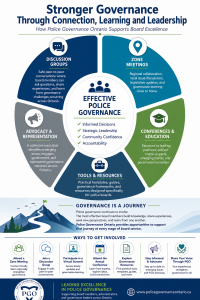
Member Benefits
PGO membership includes:
Education and Training
Practical and accessible learning that strengthens understanding of board roles, responsibilities, and decision-making.
Expertise and Knowledge Sharing
Access to governance insights, best practices, templates, and peer learning across Ontario.
Advocacy and Sector Influence
A united voice on issues that affect police governance, capacity, funding, and the broader public safety environment.
Community and Connection
Opportunities for networking, collaboration, and knowledge exchange through events, workshops, and conferences.
Insurance
Group insurance options and guidance to help OPP Detachment Boards meet legal and governance responsibilities with confidence.
Membership Categories
These descriptions follow the Community Safety and Policing Act definitions, ensuring clarity and consistency.
Municipal Police Service Boards
These boards oversee municipal police services within their communities. Membership supports their governance responsibilities, ongoing training, and alignment with provincial best practices.
First Nation Police Service Boards
These boards provide governance and oversight for First Nation police services. Membership connects them to resources, peer networks, and learning opportunities across the province while respecting the unique needs of their communities.
OPP Detachment Boards
These boards provide civilian governance for municipalities and First Nations policed by the Ontario Provincial Police within a detachment area. Membership supports board development, access to governance tools, and province-wide collaboration.
(Note: some First Nations policed by the OPP are represented within a detachment board model. The membership structure supports this.)
Associate Organizations and Individuals
Affiliate organizations are sector partners who are a part of our Expert Partner Program and are subject to the fees associated with their sponsorship level.
Membership Fees
The following fees reflect the current schedule for Municipal and First Nation Police Service Boards and remain accurate.
Municipal and First Nation Police Service Boards
Membership fees are based on the size of the police service.
| Force size | 2026 Membership Dues | HST | Total |
|---|---|---|---|
| 1-50 | $3,060 | $398 | $3,458 |
| 51-100 | $4,590 | $597 | $5,186 |
| 101-200 | $6,630 | $862 | $7,492 |
| 201-300 | $8,670 | $1,127 | $9,797 |
| Over 300 | $10,710 | $1,392 | $11,562 |
| Toronto, York, Peel, Ottawa | $15,300 | $1,989 | $17,289 |
OPP Detachment Boards
These fees align with the OPP municipal billing structure.
Current fee: 0.21 per property within the detachment area.
This approach reflects the governance responsibilities of detachment boards and ensures fairness across the province.
Associate Members
| Associate Member | 2026 Membership Dues | HST | Total |
|---|---|---|---|
| Associate Organizations | $6,916 | $899 | $7,815 |
| Associate Individuals | $658 | $86 | $744 |
Zone Fees
Many boards participate in regional or zone associations. Where applicable, these fees are collected alongside PGO dues. If integrated through GrowthZone, the system should clearly itemize PGO dues and zone fees at checkout. The fee for zone 1, 1A, 2, 3, 4, 6 are $150 per board and Zone 5 is $250 and covers all board members. These funds are collected at the time of membership renewal and dispursed back to the zone committee for zone expenses.
Frequently Asked Questions
Membership provides access to governance education, expert insights, events, sector updates, templates, tools and peer support. Members also benefit from PGO’s advocacy work, which represents the needs of police governance boards across Ontario.
Membership is open to Municipal Police Service Boards, First Nation Police Service Boards, and OPP Detachment Boards. Associate memberships are also available for individuals or organizations that support police governance or public safety.
No. Membership is held at the board level for Municipal, First Nation and OPP Detachment Boards. All appointed board members and their administrative support staff receive access.
Municipal and First Nation Police Service Boards pay fees based on the size of their police service. OPP Detachment Boards pay a per property rate that aligns with how OPP bills municipalities for policing.
Yes. They follow the same fee schedule. The only exception is First Nation communities policed by the OPP. Those boards follow the OPP Detachment Board model, which uses the per property rate of .21 cents.
Fees are based on the most recent and reliable service size data available at the time of renewal. If your service has significant changes, you can contact PGO to review your category at the next renewal period.
Fees are calculated using the number of properties in the detachment area. This is the same data used by OPP to calculate municipal policing costs and ensures consistency across billing systems.
No. Zone fees, where applicable, are collected separately and support regional collaboration, meetings and board-to-board learning. Renewal pages will clearly explain how zone fees are applied.
Yes. Members receive reduced rates for conferences, webinars and workshops. Certain training resources are also exclusive to members.
Yes. PGO offers foundational learning for new members, advanced resources for experienced members, and clear guidance that supports boards at every stage of their governance work.
PGO supports the governance role, not operations. We help boards stay compliant with legislation, understand oversight responsibilities, and strengthen their ability to make informed decisions. This complements, not replaces, the relationship with the police service.
We provide resources and training tailored to the OPP governance model, including understanding OPP billing, community representation, data interpretation and working with detachment commanders. Detachment boards have the same access to tools and support as municipal and First Nation boards.
Associate members receive access to events, communications, and learning opportunities but do not receive board-specific governance tools. They do not participate in zone structures.
Updates are managed through the GrowthZone profile. Boards can log in to make changes or contact PGO membership support for assistance.
Yes. Membership can begin at any time. Fees are applied on an annual basis and will not be prorated.
The Community Safety and Policing Act has increased expectations for training, oversight, collaboration and accountability. Membership helps boards meet these responsibilities with confidence and consistency.
Insurance for OPP Detachment Boards
Police governance changed in Ontario when the Community Safety and Policing Act, 2019 (CSPA) came into force on April 1, 2024. As part of those changes, boards that oversee Ontario Provincial Police (OPP) detachments are now established under provincial regulations and are no longer considered “local boards” under the Municipal Act. This has important implications for how these boards obtain insurance coverage.
Why Insurance Matters for OPP Detachment Boards
OPP Detachment Boards have legal and operational responsibilities. To meet those responsibilities responsibly, boards need appropriate insurance coverage. This protects the board and its members from liability related to decisions, meetings, programs, training and other official activities. Insurance helps boards operate with confidence and meet statutory governance expectations without exposing individual members to personal financial risk.
The Insurance Challenge
Because OPP Detachment Boards are no longer defined as local boards under the Municipal Act, they cannot automatically access municipal insurance programs that previously covered police service boards. Some detachments found that their existing coverage lapsed or was unclear once the new governance framework came into force.
As a result, boards must now secure their own liability and risk protection coverage. This includes standard coverages such as:
- Directors and Officers Liability – protection for board members for decisions made in their official capacity.
- Commercial General Liability – coverage for claims arising from board activities.
- Errors and Omissions / Professional Liability – coverage for advice or service delivered by a board.
- Cyber Liability – protection for digital risks.
- Non-Owned Auto Liability – covers vehicles used for official activities.
Available Options and Support
For Boards that want to participate in our Group Insurance Program [call to action button – email for details] can get more information and can download the brochure for discussion [we need to update the brochure with PGO branding but it should be available here]. Along with the coverage, check the member portal for board policy documents that may be required to complete the insurance coverage process.
Practical Advice for Boards
- Confirm Coverage Before Meetings
Boards should not meet until they have confirmed appropriate insurance coverage for all board members and activities. - Talk to Your Municipality
If your board previously relied on municipal insurance, contact your municipal clerk or risk manager to confirm whether coverage still applies or if additional arrangements are needed. - Work with a Broker
Experienced brokers can help identify policies that meet legal requirements and provide the right level of protection for your board’s size and activities.
Still Have Questions
If you need clarification about membership categories, fees, insurance, or the application process, our team is here to help.