
Artificial intelligence is moving quickly from something we talk about to something organizations and individuals are already using.
For police Boards, that raises some important questions.
What exactly is AI?
What do Board members actually need to understand about how it works, what it can do, where it can go wrong, and why human judgment and critical thinking still matter?
Where is AI already being used in policing?
As police services explore and adopt AI-enabled technologies, Boards need to understand enough to exercise meaningful governance and oversight.
What should Boards know about the technologies being used by their police service? What questions should they be asking? What are the implications for privacy, accountability, bias, policy, risk, transparency and public trust?
Boards do not need to become technology experts.
They do need to know how to govern organizations that are increasingly using technology they may not fully understand.
And then there is another question.
What about AI around our own Board tables?
Board members and administrators increasingly have access to powerful AI tools, sometimes through applications they already use.
Are individual members already using AI to research issues, summarize information, prepare for meetings or develop their thinking?
Are documents or information being entered into AI tools without a clear understanding of privacy, confidentiality or information-security implications?
Are AI-generated answers being independently verified?
Could AI be influencing Board discussions or decisions without anyone knowing it was used?
And has your Board ever discussed what responsible AI use should look like?
Before we ask how AI can help us govern better, we need to understand how it may already be affecting our governance and what appropriate guardrails should be in place.
Only then can we explore the opportunity.
Used responsibly, AI has the potential to help Boards work with information, undertake research, prepare for meetings, identify better questions, test assumptions and increase their capacity to govern.
But AI cannot exercise governance for us.
It can increase our capacity to govern. It cannot assume our responsibility to govern.
Join us on November 25.
Police Governance Ontario is bringing these conversations together for a full-day virtual summit dedicated to AI and police governance.
We will start with the fundamentals and build from there:
Understand it.
What is AI and what do governors actually need to know?
Govern it.
Where is AI being used in policing and what does meaningful oversight look like?
Look inward.
How might AI already be used around our own Board tables, and what risks does that create?
Establish the guardrails.
What policies, practices, training and expectations should Boards consider?
Use it well.
How can AI responsibly support stronger and more effective governance?
Whether you are already using AI regularly, have only experimented with it, or aren’t entirely sure what all the fuss is about, this Summit is being designed to meet you where you are and move the conversation forward.
The objective is not to turn Board members into AI experts.
It is to help us become better prepared governors in an environment that is changing quickly.
For now, we’re asking you to do one thing:
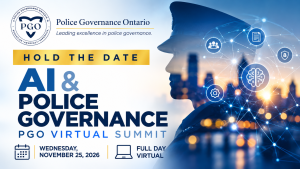
Hold the date.
Wednesday, November 25, 2026
PGO AI & Police Governance Virtual Summit
Full Day | Virtual
A full program of speakers, sessions and practical learning will be announced over the coming weeks.
Registration information coming soon.